
Lebanese art, memory and history
Lebanese art has long done more than represent a place or a moment. Across painting, photography, film, installation, sculpture and public art, artists have responded to war, reconstruction, migration, urban change, identity and the uncertain work of remembering. Their works can therefore be approached not only as aesthetic objects, but also as records of how individuals and communities experience history.
That distinction matters. A work of art is not a neutral transcript of events, and it should not be treated as one. Yet historical evidence is broader than official documents or chronological accounts. Images, objects and installations can reveal what people feared, remembered, questioned, celebrated or refused to forget. They can preserve emotional and cultural traces that conventional archives may omit, while also challenging the narratives through which a society explains its past.
For APEAL, whose exhibitions, commissions and educational initiatives have promoted Lebanese artists and expanded public engagement with Lebanese art, this relationship between artistic practice and historical memory is especially significant. Projects such as Subtitled: With Narratives from Lebanon, Convergence: New Art From Lebanon and the commissioned Letter to a Refusing Pilot demonstrate how contemporary art can enter into dialogue with conflict, testimony, place and contested memory.
History is assembled from traces. Government documents, newspapers, letters, oral testimony, photographs, maps and material objects each preserve different kinds of information. Art belongs within this wider evidentiary landscape because it records interpretation as well as observation. An artist may document a destroyed neighborhood, return to an inherited family story, reconstruct an absent archive or transform public space in order to make a social question visible.
This makes artworks particularly valuable when the historical problem involves memory, identity or lived experience. An official report may establish when an event occurred. A photograph may record what appeared before a camera. An artwork can reveal how a later generation understands that event, how memory has changed, or why a particular image continues to carry social meaning.
At the same time, the interpretive character of art requires care. A painting about conflict does not automatically describe the conflict accurately; an installation about memory does not speak for an entire population. Its historical value lies partly in its point of view. The task is to ask what the work can tell us, what it cannot tell us, and why its particular perspective matters.
Lebanon's modern history has produced complicated relationships between public memory and personal recollection. Periods of conflict and political instability have left material damage, displaced communities and competing accounts of what happened. Artists often work precisely in the spaces where a single, settled narrative is impossible.
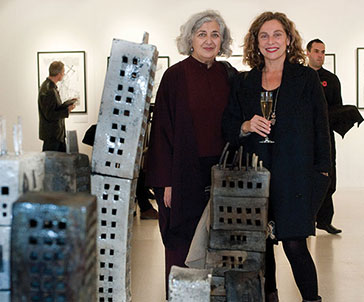
APEAL's 2011 London exhibition Subtitled: With Narratives from Lebanon brought together paintings, sculptures, mixed-media installations, photographs and films by Lebanese artists. The exhibition's accompanying discussion explicitly connected artistic practice with war, personal memory, collective amnesia, identity, public space and the recording of history. That combination is revealing: art becomes a place where evidence and interpretation meet, rather than a decorative illustration added after history has already been written.
Memory in such work can take many forms. It may be autobiographical, rooted in an artist's own experience. It may be inherited, shaped by stories passed between generations. It may depend on media images, archives or objects that survived an event. It may also draw attention to absence—to records that were never created, places that disappeared, or experiences excluded from dominant accounts.
One of the central challenges in interpreting memory-based art is scale. Personal testimony is specific, while historical narratives often seek broader explanations. The two should not be confused. A work grounded in one person's memory cannot by itself establish how everyone experienced an event, but it may disclose details, emotions or contradictions that larger narratives flatten.
For this reason, memory-based art is strongest as historical evidence when it is placed in context. The artist's biography, the date of production, the location represented, the medium used and the circumstances of exhibition all help clarify what kind of historical claim the work can support. Other sources can then confirm, complicate or challenge that interpretation.
Archives are powerful, but they are never complete. What survives often reflects institutional priorities: what governments collected, what newspapers printed, what families preserved, what museums acquired and what could physically endure. Contemporary artists can expose these limits by returning to archival material and reorganizing it, juxtaposing it with testimony, or drawing attention to what is missing.
This approach is especially important in societies marked by conflict. Images circulate rapidly during wars, but their meanings can change as they are reproduced, captioned and remembered. A photograph may appear factual while still reflecting the position of the photographer, the frame selected, the publication context and later editorial choices. Artists who reuse such images can make that process of mediation visible.
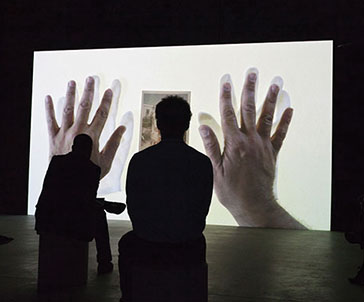
APEAL's commission Letter to a Refusing Pilot, presented for the Lebanese Pavilion at the 2013 Venice Biennale, is a useful example of this method. The film and video installation revisited a story associated with the 1982 war and considered the excavation of narratives and the circulation of images in wartime. Rather than simply presenting a historical episode as settled fact, the work foregrounded the way stories are transmitted, investigated and reinterpreted.
An artwork becomes most useful as historical evidence when it is read in relation to other evidence. Interpretation should move between the object itself, its maker, its historical setting, its later reception and the documentary record around it.
Visual interpretation begins with attention before explanation. It is easy to approach an artwork with a ready-made story about Lebanon, conflict or identity and then select only the details that confirm it. A stronger method starts with what is materially present and builds outward toward context.
For researchers, the practical challenge is learning how to analyze art as a primary source: begin with what the object shows, then ask who made it, when, for whom, under what conditions, and how its claims compare with other evidence. This method respects both sides of the object—its status as an artistic construction and its ability to preserve historically meaningful information.
Photography and film often appear to offer direct access to the past because they are produced through cameras. Yet they are no less dependent on perspective and selection than other historical sources. A camera records what is placed before it, but someone still chooses where to stand, when to record, what to exclude and how the resulting material will be edited or exhibited.
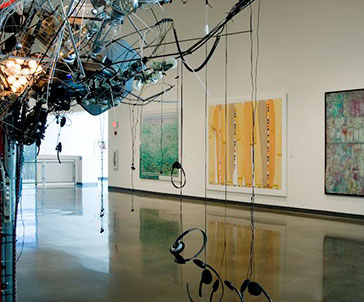
APEAL's Convergence: New Art From Lebanon incorporated photography, digital animation, film and architectural projects alongside painting and sculpture. That range matters because modern Lebanese visual culture cannot be reduced to one medium. Different formats record different dimensions of experience: a photograph can isolate a fleeting detail, film can unfold a narrative in time, and an installation can place viewers physically inside a constructed relationship between objects, images and space.
When used historically, such works should therefore be treated as testimony with a viewpoint. The most productive question is not simply whether an image is "true," but what kind of truth it is able to communicate: factual, experiential, symbolic, political or memorial.
Historical interpretation is not confined to museums and archives. Public art can make streets, squares, airports and civic spaces part of the conversation. A sculpture placed in a changing city acquires meaning through its surroundings; an installation concerned with urban growth or social memory interacts with the physical landscape rather than remaining separate from it.
APEAL's commissioning program described public art as a means of enriching Lebanon's cultural fabric and contributing to a forward-looking post-conflict society. Works engaging with cities, transformation and identity show why location itself can function as evidence. Buildings, demolished sites, reconstructed districts and new cultural institutions all carry layers of historical meaning that artists can reveal or contest.
This spatial dimension is particularly important in Beirut and other Lebanese cities, where architecture and urban development can make historical change visible. Public art can ask viewers to notice what has disappeared, what has been rebuilt and whose memories remain legible in the contemporary city.
Art does not enter public memory by itself. Curators, museums, cultural organizations and publishers influence which works are preserved, grouped and interpreted. The selection of objects for an exhibition creates relationships between them; titles and wall texts establish frames; catalogues preserve research; educational programs extend interpretation beyond the gallery.
This makes curatorial practice part of the history of art as evidence. An exhibition about Lebanon is not only a collection of individual works. It is also an argument about which themes matter, how works speak to one another and how audiences might understand a particular cultural moment.
APEAL's historical commitment to exhibitions, publications, scholarships and the development of curatorial and museum expertise reflects this broader ecosystem. Supporting artists is one part of cultural preservation; supporting the people and institutions capable of researching, interpreting and presenting their work is another.
Taking art seriously as historical evidence does not mean treating every artistic choice as literal fact. Interpretation becomes unreliable when symbolism is mistaken for documentation, when one artist is assumed to represent an entire community, or when a work is detached from the circumstances in which it was produced.
There is also a danger in reading contemporary works only through conflict. Lebanese artists address an enormous range of subjects, and reducing their work to war or trauma can reproduce the very simplifications that careful historical interpretation should resist. Formal experimentation, humor, intimacy, everyday life, architecture, technology, migration and imagined futures can be historically revealing too.
A responsible approach therefore combines close looking with contextual research. It asks what the artwork contributes to knowledge without demanding that it perform the role of an official record. Contradiction is not necessarily a weakness. When several works remember the same period differently, those differences may themselves reveal how history continues to be negotiated.
To preserve art is to preserve more than physical works. It is also to preserve the questions, memories and interpretations attached to them. Exhibitions, catalogues, scholarship, oral histories, conservation records and digital documentation all help future audiences reconstruct the contexts in which art was made and understood.
Lebanese artists have repeatedly transformed personal experience, collective memory and contested history into visual form. Their works do not replace archives, eyewitness accounts or historical scholarship. Instead, they enlarge the archive by showing how history feels, how it is remembered and how its meanings change across generations.
That is why art deserves a place in serious historical inquiry. A work can be aesthetically powerful and historically useful at the same time. Read critically and alongside other sources, it can preserve traces that conventional records miss—and remind us that the past survives not only in documents, but also in images, objects, spaces and acts of interpretation.


